
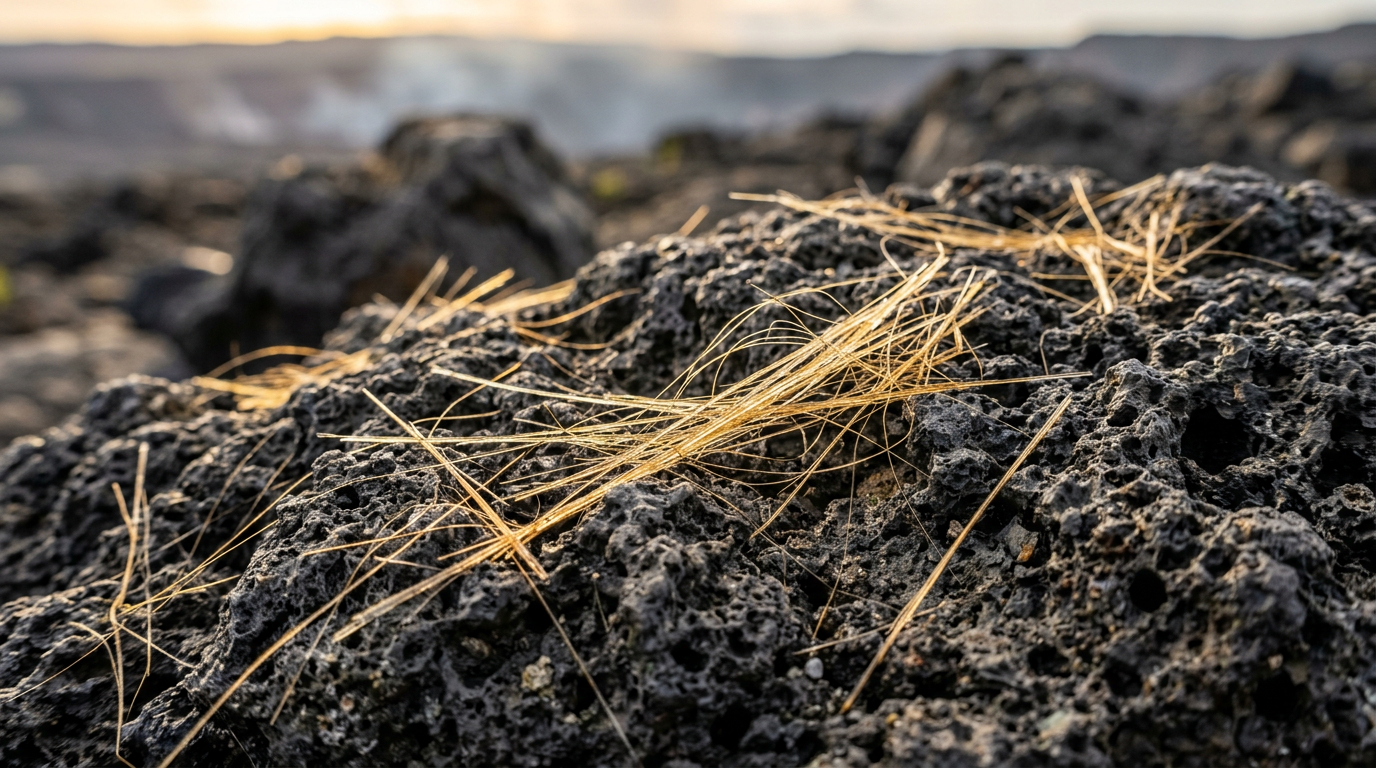
The strands are as fine as silk yet as sharp as a needle. For decades, the phenomenon of Pele’s hair—thin, elongated filaments of basaltic glass found near active volcanic sites—has remained a point of both spiritual reverence and geological inquiry. However, a significant breakthrough published this week, resulting from a unique partnership between a multidisciplinary team of scientists and professional glass artists, has finally mapped the precise fluid dynamics that transform molten earth into these gossamer threads.
According to the researchers, the formation of these structures is not merely a byproduct of wind, as previously hypothesized in simpler models, but is the result of a complex interplay between air-filled magma and extreme mechanical stretching. The study suggests that when gas-rich magma is expelled during fountaining eruptions, the bubbles within the melt provide the necessary surface tension and internal pressure to allow for drastic elongation. As the magma is ejected into the atmosphere, the rapid cooling process captures the liquid in a state of mid-stretch, effectively freezing the kinetic energy of the eruption into a solid, albeit brittle, form.
What makes this investigation particularly notable from a policy and academic perspective is the methodology employed. By integrating the tactile, experiential knowledge of glass artists with the rigorous computational modeling of volcanologists, the team was able to replicate volcanic conditions in a controlled setting. The glass artists provided the process-based insights—specifically, how viscosity and temperature allow for the manual pulling of fine threads—which the scientists then translated into mathematical constants. This cross-pollination of disciplines underscores a significant shift in how complex geological phenomena are studied in the modern era.
This interdisciplinary approach highlights a growing trend in research funding where the intersection of the arts and empirical science is viewed not as a novelty, but as a necessity for solving complex physical puzzles. Proponents of this integrated model argue that the creative intuition of artisans can often bypass the limitations of traditional laboratory observation. In the case of Pele’s hair, the artists' ability to manipulate molten materials provided the missing link in understanding how high-velocity gas jets interact with viscous fluid in the natural world.
Beyond the aesthetic wonder of these glass fibers, the findings have practical implications for global volcanic hazard assessment. Understanding how magma fragments and stretches can help geologists better predict the dispersal of volcanic ash and glass—materials that pose significant risks to aviation, agriculture, and respiratory health in downwind communities. As volcanic activity continues to be a primary concern for infrastructure stability in island nations, the clarity provided by this study is a vital tool for public safety planners.
Ultimately, the study serves as a reminder that the natural world often operates at the edge of chaos and elegance. The hair of the volcano is a testament to the violent forces of the mantle, yet its existence depends on a delicate balance of physics that we are only now beginning to fully comprehend. The collaboration marks a high point for interdisciplinary study, proving that when we bridge the gap between the laboratory and the studio, we gain a more profound understanding of the ground beneath our feet.
About Olivia Sterling
Political Correspondent
Education Policy Analyst tracking federal funding, student loan legislation, and K-12 standards.
View Full Profile & Work →Continue Briefing
Additional intelligence reports from the network
More Headlines

Sen. Chris Coons Weighs in on Trump's New Nominee for National Intelligence Director
JUN 12 • 2026, 5:00 AM ET
Trump Nominates Jay Clayton to Serve as Director of National Intelligence
JUN 12 • 2026, 5:00 AM ET


Air India Crash Families' Year-Long Battle to Identify Remains of Victims
JUN 12 • 2026, 4:01 AM ET