
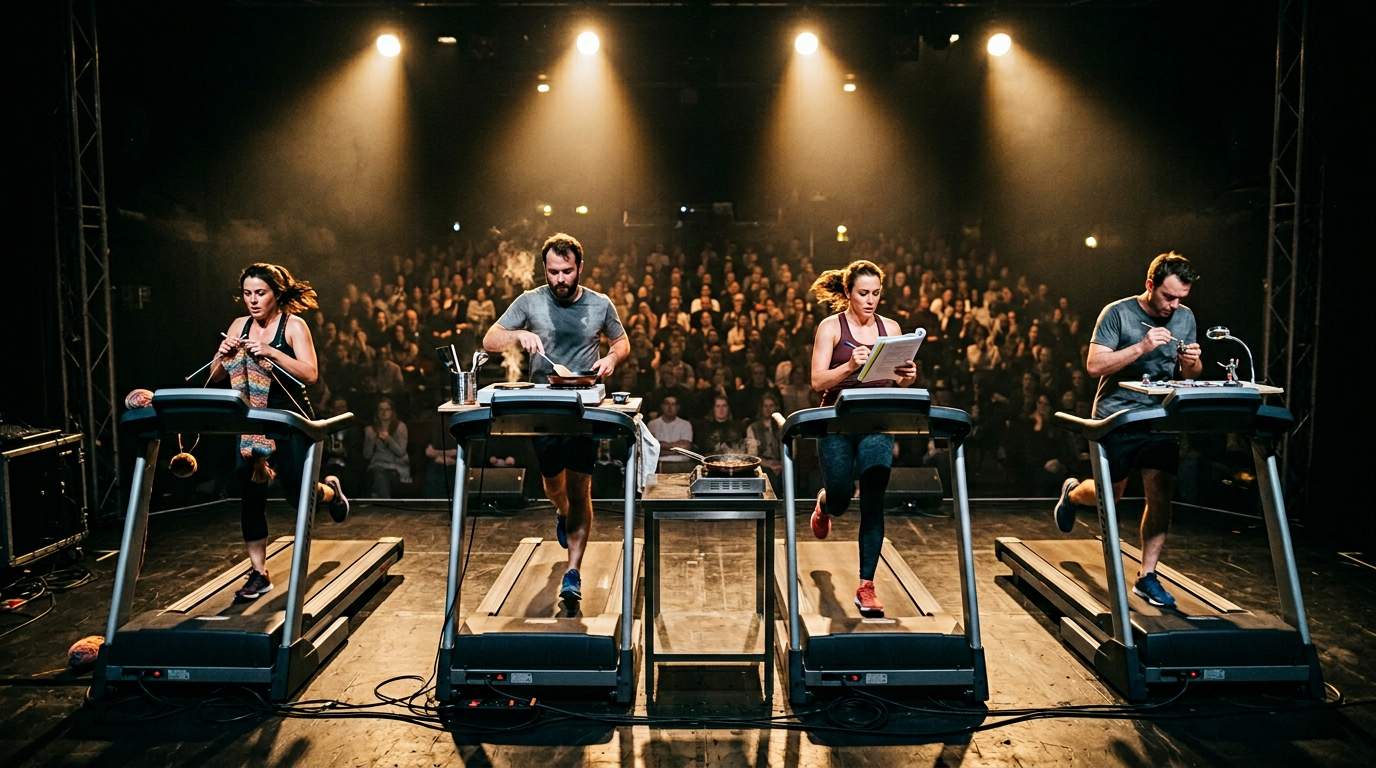
The lights of Off-Broadway have long illuminated the complexities of the human condition, but the new production “Burnout Paradise” offers a particularly visceral critique of the modern American psyche. At first glance, the premise seems like a fitness-obsessed fever dream: four performers, four treadmills, and a series of increasingly absurd tasks ranging from making omelets to knitting, all performed while jogging at a steady, relentless clip. However, through the lens of political and labor analysis, one cannot help but see the production as a biting allegory for the legislative gridlock and the relentless “treadmill” of the 21st-century labor market.
The stakes of the performance are uniquely high and purposefully transparent. If the performers fail to meet their predetermined time goals, the audience is promised a full refund. In an era where political accountability often feels like a relic of the past, this “money-back guarantee” on artistic effort serves as a radical manifesto. While our elected officials frequently campaign on ambitious platforms only to cite “process” or “partisan friction” as reasons for their inevitable failure, the cast of “Burnout Paradise” offers no such excuses. They either perform at peak capacity or they pay the price—literally. This fiscal vulnerability creates a tension that mirrors the real-world anxieties of a workforce living paycheck to paycheck.
This physical manifestation of “burnout” reflects a growing discourse in Washington and across various labor unions regarding worker protections and the psychological toll of the gig economy. The performers are not merely acting; they are enduring. This mimicry of the over-burdened constituent—tasked with maintaining a “jogging pace” in life while juggling rising costs, healthcare complexities, and social obligations—resonates with a public tired of empty rhetoric. The treadmills are not just stage props; they are kinetic symbols of an economic system that demands constant movement and growth with no clear destination or resting point.
Reports from The New York Times have noted that the sheer exhaustion of the performers creates a bond with the audience that transcends typical theater. From a policy perspective, this bond mirrors the “exhaustion” cited by voters in recent polling regarding the upcoming election cycles. There is a palpable sense that the American public is also running on a treadmill, waiting for a “refund” on a social contract that seems increasingly difficult to cash in. The visceral nature of the sweat and the struggle on stage makes the abstract concept of “burnout” a tangible, communal experience.
Furthermore, the collaborative nature of the tasks—how the four performers must synchronize their efforts to avoid collective failure—highlights the necessity of coalition-building. In a political landscape defined by extreme polarization, “Burnout Paradise” suggests that survival requires a shared rhythm. If one runner trips or falls behind, the entire fiscal model of the show collapses. Ultimately, the play is a stark reminder that productivity without purpose leads only to collapse. By framing the burnout of the average worker as a high-stakes theatrical gamble, the creators force us to reckon with the sustainability of our current economic trajectories. As the audience watches the sweat drip onto the moving belts, the question remains: how much longer can the collective “we” keep up the pace before the system demands its money back?
About Christopher Hayes
Political Correspondent
Veterans Affairs Reporter dedicated to tracking legislation and policy impacting military veterans.
View Full Profile & Work →Continue Briefing
Additional intelligence reports from the network
More Headlines


Ukraine's Drone Strikes: A 'Justified' Response to Russian Aggression?
MAY 18 • 2026, 5:01 AM ET
Driver of Crashed Train in Thailand Tested Positive for Drugs, Raises Concerns Over Safety
MAY 18 • 2026, 4:02 AM ET
Eurovision 2024: Bulgaria's Dara Takes the Crown, Ukraine Breaks a Record
MAY 18 • 2026, 4:01 AM ET
